Is Snorkeling in Cabo San Lucas Safe? An Honest Answer
Is snorkeling in Cabo San Lucas safe? Yes, in the bays every boat actually visits, with one real exception you need to know before you book. Pelican Rock, Lover's Beach and the Tourist Corridor reefs sit inside a calm, current-sheltered bay where crews brief every guest and hand out flotation before anyone gets in the water. The one place that drags on the safety record is a beach most snorkel boats never touch, Divorce Beach, on the open Pacific side of the same rocky point, a two-minute walk from the calm side. We have crewed pangas and catamarans out of this marina since 2011, and that two-minute walk is the single fact worth remembering most. Read on for the restrictions table and how we vet an operator before sending guests. For the full lineup, see small-group snorkel trips in Cabo San Lucas.
Quick answer
Snorkeling in Cabo San Lucas is safe on the Sea of Cortez side of the bay, at Pelican Rock, Lover's Beach and the Tourist Corridor reefs, where crews brief every guest and hand out flotation before anyone gets in the water. The one real exception is Divorce Beach on the Pacific side, two minutes' walk from Lover's Beach, where heavy shore break and no lifeguards make it a walk-only stop. No authority publishes an incident rate for snorkeling here, so treat anyone quoting you one as guessing.
Key takeaways
- The one place to avoid entirely: Playa del Divorcio, walk-only, no lifeguards, heavy Pacific shore break
- The crowd-free morning panga snorkel at $70 runs with a crew that briefs every guest and hands out flotation before anyone gets wet
- Non-swimmers, age limits and pregnancy each get their own row in the restrictions table below rather than a one-line answer
- Excluded by age or a medical condition? The Land's End Arch sightseeing and Lover's Beach trip covers the same water without anyone swimming
- Hurricane season adds its own cancellation risk, covered in full on when to book your trip
- No authority publishes an incident rate for snorkeling in Cabo San Lucas
The One Place You Must Not Swim
Land's End ends in a narrow spit of sand with two beaches on it, and the two beaches could not behave more differently. Playa del Divorcio, Divorce Beach, sits on the open Pacific side, where ocean swell rolls in unbroken and meets a bottom that shelves off fast. The shore break is heavy, there are no lifeguards, and drownings have happened there over the years.
Every panga captain and dive guide in this town repeats the same rule to every group: walk across for the photo, never step past your ankles.
A two-minute walk away, on the Sea of Cortez side of that same sand spit, is Lover's Beach, Playa del Amor, where the water goes calm and the snorkeling actually happens. Pelican Rock sits just off Lover's Beach on the bay side, sheltered from the Pacific swell by the whole rocky spine of Land's End. It is the same point of land, two completely different oceans meeting it, and that contrast, not some general warning about Mexican beaches, is the one fact that matters most in this guide.
For the access details, boat schedules and where the water taxis actually drop you, see where to snorkel in Cabo San Lucas.
What Makes the Bays Safe
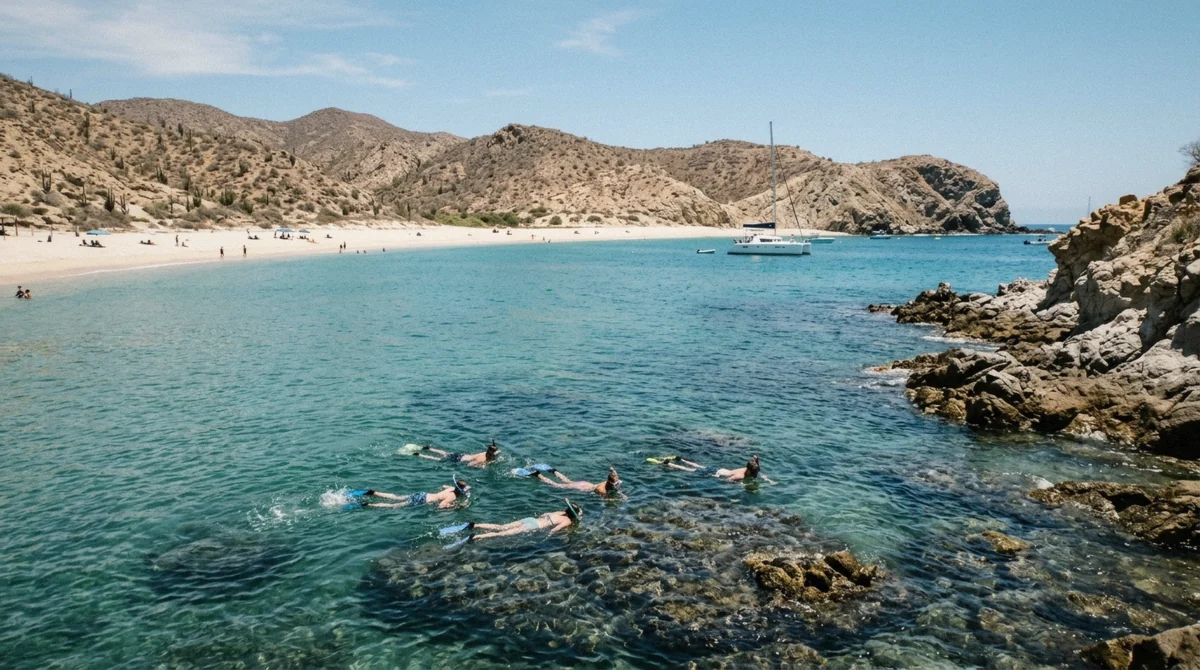
The water where these trips actually operate sits inside the Area de Proteccion de Flora y Fauna Cabo San Lucas, a federal protected area managed by CONANP. That status does not make the bay a swimming pool, but it does mean the zone is patrolled, the reef gets some real protection from anchors and runoff, and the boats working it know the terrain well enough to point out a moray under a ledge without anyone panicking.
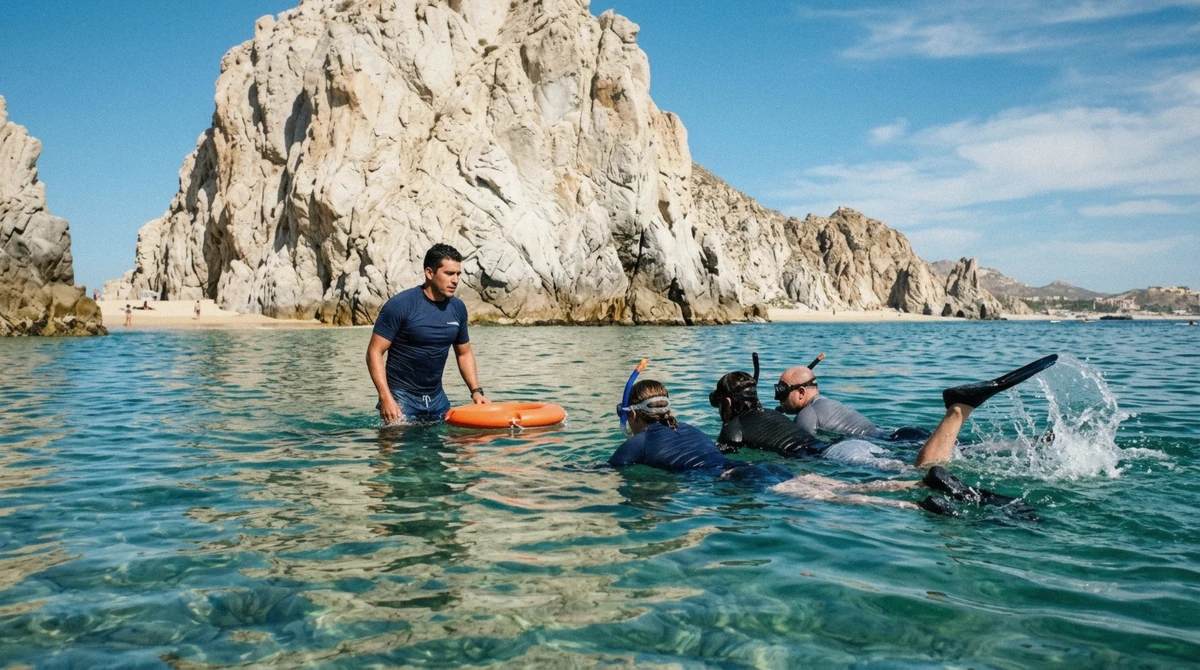
The bigger safety factor is simpler than any regulation: a life jacket for every guest who wants one, and a crew member in the water with the group rather than watching from the boat. On the trips we compare, weak swimmers get a life jacket or a pool noodle without having to ask twice, and the briefing before anyone gets wet covers where the boundary marker or the guide's float sits for the day.
Weather is the other lever, and it is not the operator's call. When a storm builds, the Capitania de Puerto, the Mexican port authority, raises the flag and orders a cierre de puerto that stops every small vessel in the harbor, snorkel boats included, whether the captain agrees with the call or not. Hurricane season and how it shapes the calendar gets its own full breakdown on the best time to snorkel in Cabo San Lucas.
The Real Risks and How Crews Manage Them
None of this is risk-free, and pretending otherwise would be exactly the kind of operator-speak we are trying to avoid here. Below is what actually goes wrong on an average season of trips, and what a crew that knows what it is doing does about each one.
| Situation | What a good crew does | Warning sign |
|---|---|---|
| Sunburn on the back and shoulders | Hands out or reminds guests to wear a rash guard, since a shirt beats sunscreen for both skin and reef | Guest skips the rash guard and floats face down for over an hour |
| Seasickness on the open-water legs | Suggests medication about 30 minutes before boarding and seats queasy guests where the ride runs smoothest | Guest looks pale and quiet before the boat has even left the marina |
| A weak swimmer in choppy water | Fits a life jacket or pool noodle before anyone asks, and keeps that guest close to the guide | Guest waves off the life jacket to look more confident than they feel |
| Urchins and cuts from standing on the reef | Briefs guests to float rather than stand, and watches for anyone drifting into shallow rock | Guest keeps trying to touch bottom to rest instead of floating |
| Dehydration on a multi-hour trip | Keeps water on board and pushes guests to drink even when nobody feels thirsty yet | Guest reports a headache or leg cramps midway through the trip |
| Boat traffic inside the bay | Keeps the group inside the marked snorkel area and near the guide's float, away from the main channel | Guest drifts toward open water chasing a fish or a better photo |
None of these situations are dramatic, and that is the point. The trips that go wrong are almost always a small thing left unmanaged, not one catastrophic event.
Who Should Think Twice
Every operator sets its own version of these rules, and the wording varies from boat to boat, so treat the table below as what to expect rather than a fixed number to hold anyone to. Where a specific figure is not published anywhere, the honest answer is to ask before you book, not to guess.
| Restriction | Typical rule on Cabo boats | Why it exists | Ask before booking if... |
|---|---|---|---|
| Swimming ability | Non-swimmers are welcome on most trips with a life jacket and a crew member close by | The water still moves, even inside a sheltered bay | you are a genuinely nervous or non-swimmer and want a guide within arm's reach the whole time |
| Minimum age | Operators set this individually, so ask before you book | Younger children can struggle with a mask seal, cold water or a moving boat | you are traveling with a child under about 6 or 7 |
| Pregnancy | Operators set this individually, so ask before you book | Boat motion, sun exposure and the physical effort of swimming carry more weight in pregnancy | you are pregnant, at any stage |
| Heart condition or high blood pressure | Operators set this individually, so ask before you book | Sudden cold water and boat motion both raise physical strain | you manage a heart condition or blood pressure with medication |
| Back problems or recent surgery | Operators set this individually, so ask before you book | Getting in and out of a moving panga puts real strain on a healing back | you have had surgery in the last few months or a chronic back issue |
| Alcohol before boarding | Most operators reserve the right to turn away a visibly intoxicated guest | A drunk guest in open water is a genuine hazard to themselves and the group | you are combining a bar crawl with a boat trip the same morning |
| Flying within 24 hours after diving | Standard dive-industry guidance, not specific to one Cabo operator | Ascending to altitude too soon after diving raises the risk of decompression sickness | your trip combines scuba with a flight home the same day or the next morning |
If more than one of these applies to you, the honest move is to call the operator directly before you pay for anything. A short phone call settles more of this than any table on a blog post ever will.
What to Book for Your Situation
If you cannot swim and the water still appeals
take a bay trip with a life jacket and a guide in the water, like the crowd-free morning panga snorkel, and tell the crew before you board
If you get seasick on small boats
pick a morning departure and a larger, steadier catamaran, and take the medication half an hour before you leave the dock
If you are traveling with young children
stay inside the sheltered bay at Pelican Rock and Lover's Beach on the $71 Arch and Lover's Beach trip, and skip the open-water crossings
If a medical condition rules out swimming altogether
the $19 Land's End sightseeing loop keeps you dry and still gets you past the Arch and the sea lion colony
If you are a strong swimmer looking for open water
the offshore shark trip is a deliberate step up, not a bay snorkel, and it is the one product here that genuinely requires confidence in deep water
How to Pick a Safe Operator
This is the one part of the whole trip you actually control. The bay is calm most mornings and the crew is the variable, so here is what we look for before recommending anyone. Prices below are in US dollars, with peso amounts converted at about 17.3 pesos to the dollar, checked in early August 2026.
Last verified: August 2026.
- A real briefing before anyone gets in the water, not a rushed safety line while guests are already climbing over the rail
- Life jackets and pool noodles visibly on board and offered without anyone having to ask
- A crew member in the water with the group, not just watching from the boat
- A captain willing to change the route or call off a departure in marginal weather rather than push it
- Clear, published cancellation terms, free cancellation up to 24 hours before departure is standard on the trips we compare
- A guide who skips the briefing entirely or rushes through the waiver so guests barely read it
- Crew talk of squeezing one more group onto a boat that already looks full
- Gear that looks worn, mismatched or missing straps
- Nobody checking who can and cannot swim before the boat leaves the dock
The Cabo Arch and Lover's Beach snorkeling tour, our top-rated small-group option at $71 (about 1,230 pesos), runs exactly this kind of briefing every departure, which is a large part of why it holds a 4.9 rating across 338 reviews. It gets the same treatment on the full Cabo Arch and Lover's Beach snorkeling tour writeup. If you would rather skip the calm-bay swim entirely for open water with confident swimmers only, the shark snorkel at $200 (about 3,460 pesos) is worth knowing about here for one reason: it is a deliberate, separate product for strong swimmers, not evidence that sharks are a hazard on the regular bay trips.
Nobody snorkeling at Pelican Rock or Santa Maria needs to think about sharks at all.
What Happens If Something Goes Wrong
Most of what goes wrong on a snorkel trip is small and gets handled before it becomes a story. Here is the honest version of what to expect.
A guest panics in the water
It happens more often with first-time snorkelers who breathe wrong into the mask and startle. A good crew member reaches that guest fast, gets a hand on the life jacket, and talks them through slow breathing rather than hauling them straight back to the boat, which usually only spikes the panic further. Your move is simple: raise a hand and call out the moment you feel it starting, rather than trying to push through it alone.
The wind picks up mid-trip
Cabo's bay is calmest in the morning, and the afternoon breeze is a known, ordinary pattern, not an emergency. A crew that has done this for years will cut a trip short or move the group to a more sheltered stretch of water. Your move is to trust an early move back to the boat rather than pushing to finish a planned route once the water has clearly turned choppy.
A port closure cancels your morning
This is a Capitania de Puerto call, not the operator's preference, and it happens without much warning when a storm is genuinely close. Every trip we compare carries free cancellation up to 24 hours before departure, and a boat that cannot sail refunds or reschedules the weather cancellation. Your move is to book your snorkel early in your trip rather than on the last available morning, so a closed port still leaves you a spare day.
Across all of it, the one lever that is genuinely yours is choosing an operator with a real briefing and disclosing anything about your own swimming or health honestly before you board, rather than after something has already gone wrong.
If You Can't Snorkel
If the restrictions table above rules you out, or you would simply rather not get in open water, you still have real options here rather than a flat no. The Land's End Arch sightseeing and Lover's Beach trip at $19 (about 330 pesos) is mainly a scenic boat loop rather than a full snorkel trip, and it is worth saying plainly every time it comes up: it gets you past the Arch, the sea lion colony and both beaches from the water without anyone needing to swim at all. The full Land's End Arch sightseeing and Lover's Beach writeup covers what the boat loop actually includes.
For anyone excluded by age, pregnancy or a medical condition rather than by choice, that same sightseeing route, or simply a beach day at Santa Maria or Chileno Bay without going past ankle depth, keeps the whole trip on the table. The full walkthrough of Cabo San Lucas marine life is worth a read even if you end up watching from the boat rather than the water, since the sea lion colony and the Arch are visible either way. The crowd-free morning panga snorkel is also a gentler option worth asking about, since its smaller groups make it easier for a crew to give one nervous swimmer extra attention.
Snorkeling in Cabo San Lucas is safe for most people who want to try it, genuinely not for everyone, and the honest answer to which group you are in usually takes one short phone call to an operator rather than a guess. Book with a crew that briefs properly, stays in the water with the group, and treats your own disclosure about swimming ability or health as useful information rather than an inconvenience, and the bay does the rest. For the full lineup of trips we compare against each other on exactly these terms, see the snorkel trips we compare.
Frequently Asked Questions
Is it safe to snorkel in Cabo San Lucas?
Yes, in the bays where the trips on this site actually operate: Pelican Rock, Lover's Beach and the Tourist Corridor reefs. The one place to avoid is Divorce Beach on the Pacific side, which is walk-only and has no lifeguards.
Why is Divorce Beach dangerous?
Playa del Divorcio sits on the open Pacific side of the Land's End spit, where the shore break is heavy, the bottom shelves off fast and there are no lifeguards. Drownings have happened there over the years, which is why every local guide treats it as a photo stop, not a swimming beach.
Can non-swimmers go on a Cabo San Lucas snorkeling tour?
Yes, on the trips we compare. Crews fit weak swimmers with a life jacket or pool noodle and stay close in the water. If you are a genuinely nervous swimmer, the Land's End Arch sightseeing and Lover's Beach trip skips the swimming altogether and still covers the same water.
What is the minimum age for snorkeling tours in Cabo San Lucas?
Operators set this individually rather than following one citywide rule, so ask before you book if you are traveling with a young child. Most trips work fine for children old enough to keep a mask seal and sit still in a moving boat.
Can you snorkel in Cabo San Lucas while pregnant?
This is another one operators decide individually rather than by a published rule, so call ahead and be upfront about it. Boat motion and sun exposure are the two factors crews weigh most.
Are there sharks that threaten snorkelers in Cabo San Lucas?
No. The regular bay trips at Pelican Rock and Lover's Beach have nothing to do with sharks. The $200 open-ocean shark snorkel is a separate, deliberate trip built for confident swimmers, not a risk that shows up on an ordinary snorkel.
What should you ask an operator before booking?
Ask how the briefing works, whether a crew member gets in the water with the group, what the cancellation policy covers, and whether your specific swimming ability, age or medical situation needs a heads-up before you pay for anything.