What Fish Can You See Snorkeling in Cabo San Lucas?
On most snorkel trips here you will spot king angelfish, sergeant majors and a handful of other reef regulars almost without trying, often a curious California sea lion too, and on a good day something rarer like a green turtle or a mobula ray passing through open water. What fish can you see snorkeling in Cabo San Lucas comes down to which tier of sighting you are hoping for, and we rank all of it by honest likelihood below rather than the usual promise-everything species list. We have guided these reefs since 2011 and this is what we actually see, trip after trip, not what a brochure claims. For the current lineup, see guided reef snorkeling in Cabo San Lucas.
Quick answer
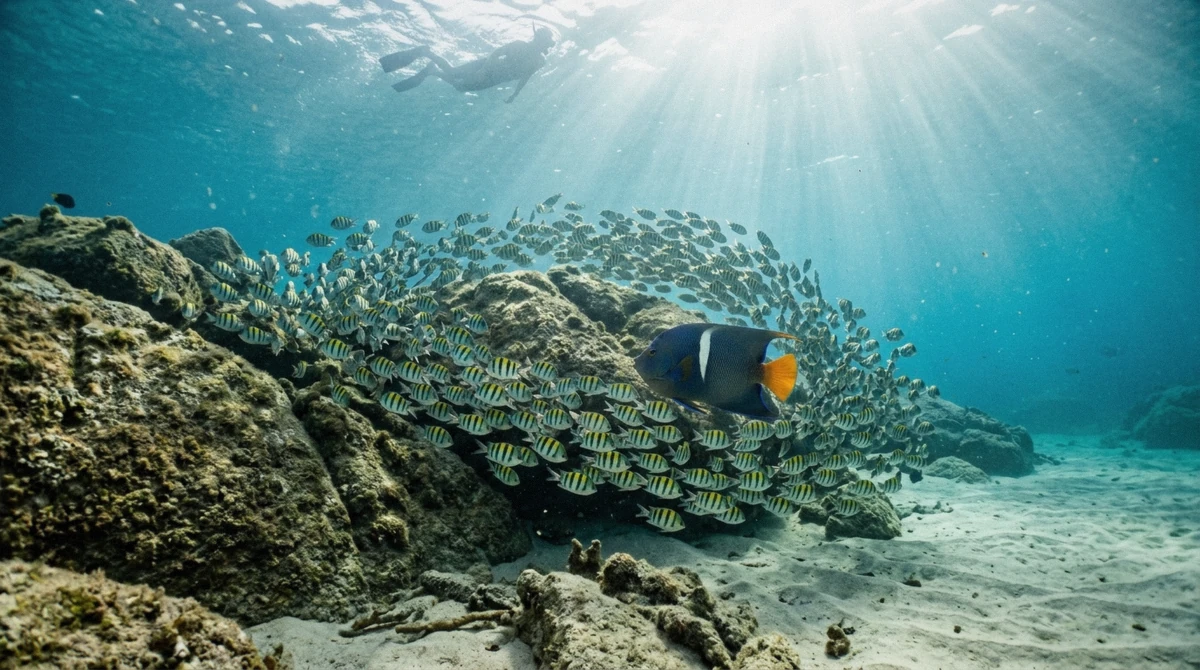
You will almost always see king angelfish and Panamic sergeant majors on the reef, very often Cortez rainbow wrasse, parrotfish and a curious California sea lion near Land's End, and on a good day a green turtle, a mobula ray or a humpback whale passing offshore. Whale sharks are not part of this picture, that animal belongs to La Paz, not Cabo San Lucas.
Key takeaways
- Nearly every trip: king angelfish and Panamic sergeant majors on almost every reef stop
- Most trips: Cortez rainbow wrasse, parrotfish and moray eels tucked into the rock
- The Land's End colony of California sea lions is a most-trips sighting, and never a swim-with encounter
- Lucky-day sightings: green and hawksbill turtles, mobula rays, and a humpback whale from the boat in season
- The myth to drop before you book: whale sharks are a La Paz animal, not a Cabo San Lucas one
- The reef stop that puts you over the fish fastest is the $71 Arch and Lover's Beach trip, and the month-by-month conditions guide says when the water is clearest
What You'll See at a Glance
The table below is the one place on this site that carries the full species list with likelihood ranked honestly, in the order you are actually likely to see them, not alphabetically. We use only five likelihood phrases across this whole post: nearly every trip, most trips, regular but not every trip, lucky-day sighting, and rare. Nothing stronger than that.
| Species | Where in Cabo | Best months | How likely |
|---|---|---|---|
| King angelfish | Pelican Rock reef | Year-round | Nearly every trip |
| Panamic sergeant major | Pelican Rock, Santa María, Chileno | Year-round | Nearly every trip |
| Cortez angelfish | Pelican Rock, Land's End rock ledges | Year-round | Most trips |
| Mexican goatfish | Sandy patches near Pelican Rock and Chileno | Year-round | Most trips |
| Cortez rainbow wrasse | Pelican Rock, Chileno reef | Year-round | Most trips |
| Parrotfish | Chileno's larger reef | Year-round | Most trips |
| California sea lion | Land's End colony | Year-round | Most trips |
| Moray eel | Rock crevices at Pelican Rock and Land's End | Year-round | Regular but not every trip |
| Pufferfish and spotted boxfish | Pelican Rock ledges | Year-round | Regular but not every trip |
| Green and hawksbill sea turtles | Chileno Bay and the corridor reefs | Best odds roughly May to November | Regular but not every trip |
| Mobula rays | Open water between the spots | Spring into early summer | Lucky-day sighting |
| Humpback whale (from the boat) | Offshore, watched from the boat | Mid-December to mid-April, strongest January to March | Lucky-day sighting |
The Sea of Cortez that these bays open into holds more than 800 fish species and sits inside the UNESCO Islands and Protected Areas of the Gulf of California World Heritage inscription, which is roughly why Jacques Cousteau once called it the world's aquarium. What that means on a normal snorkel is that the reef fish rows above are close to a sure thing, the sea lion colony is close behind them, and everything from the turtles down is genuinely a matter of the day you get. For where each of these spots actually sits and how you reach it, see our guide to the snorkeling spots.
Nearly Every Trip
King angelfish
A bold, upright fish in navy blue with a bright yellow tail and a sharp white bar behind the head, easy for a first-timer to spot even from a distance. Found reliably around the boulders and ledges at Pelican Rock, patrolling the same stretches of reef day after day. Likelihood: nearly every trip.
We watch juveniles a fraction the size of the adults hovering in the same cracks, a completely different color pattern, and it still surprises new snorkelers that the two are the same species.
Panamic sergeant major
A small, striped fish, yellow-grey with dark vertical bands, usually seen in loose schools rather than alone. They turn up at Pelican Rock, Santa María and Chileno without much effort, hovering just above the rock in the shallow, sunlit water where new snorkelers first put their face in. Likelihood: nearly every trip.
During their spawning window the males turn a deeper, almost purple shade while guarding a patch of eggs on the rock, a detail most people never notice unless a guide points it out.
Cortez angelfish
Similar shape to its king angelfish cousin but a darker, more mottled coloring with a distinctive black spot near the tail. It shares the same rock ledges at Pelican Rock and around Land's End, often hanging back a little more cautiously than the bolder king angelfish nearby. Likelihood: most trips.
The crowd-free morning panga snorkel times its early departures around exactly this stretch of reef, when the light is still low and the fish are least skittish.
Mexican goatfish
A slim, silvery fish that hunts the sandy patches between rocks, using two long barbels under its chin to feel for prey buried in the sand. You will usually find small groups working the open sand near Pelican Rock and Chileno rather than sitting still on the reef itself. Likelihood: most trips.
Watching one actually feed, barbels sweeping the bottom, is one of those small behaviors that makes a slow patch of sand worth a second look instead of swimming straight past it.
Most Trips
Cortez rainbow wrasse
A small, quick-moving fish that lives up to its name, streaked with pink, yellow and blue depending on the light. It darts through the reef at Pelican Rock and Chileno in short bursts rather than cruising slowly, which makes it one of the harder fish to photograph well. Likelihood: most trips.
Like several wrasse species, individuals can change sex over their lifetime, starting female and later becoming male, a detail that always gets a reaction when we mention it mid-swim.
Sunset wrasse
A brighter, more orange-toned cousin of the rainbow wrasse, often seen weaving through the same rocky stretches at slightly deeper water than the shallow reef top. Likelihood: most trips. It shares habitat closely with the Cortez rainbow wrasse, so spotting one is usually a matter of slowing down and watching a patch of reef rather than covering more ground.
Parrotfish
Thick-bodied, brightly colored, and unmistakable once you have seen one, parrotfish graze algae off the rock with a beak-like mouth built from fused teeth, and you can sometimes hear the crunch underwater before you see the fish itself. Chileno's larger reef is the most reliable spot for a good-sized adult. Likelihood: most trips.
The catamaran snorkel to the Arch and Santa María reaches reef structure where parrotfish activity tends to be steady through the warmer months.
Moray eel
Usually just a head poking out of a crevice, mouth opening and closing as it breathes, not the aggressive creature its reputation suggests. Found tucked into rock crevices at both Pelican Rock and around Land's End. Likelihood: regular but not every trip, since it depends on a guide spotting one tucked into shadow rather than the eel being out and visible.
It hunts mostly at night and by scent rather than sight, which is exactly why daytime sightings are a matter of luck and a sharp-eyed guide rather than the eel being rare.
Pufferfish and spotted boxfish
Slow, almost comically deliberate swimmers, easy to approach without disturbing them, usually found drifting near the ledges at Pelican Rock. Likelihood: regular but not every trip. If startled, a pufferfish can inflate by pulling in water, a genuine defense mechanism rather than a show, though a respectful distance means you rarely see it triggered on a normal snorkel.
Lucky-Day Sightings
Green and hawksbill sea turtles
The turtles snorkelers here actually see are green turtles and hawksbills, most often at Chileno Bay and along the corridor reefs, with the best odds roughly May through November. Likelihood: regular but not every trip, honest odds rather than a promise. A turtle grazing on the reef will often let a slow, quiet swimmer approach fairly close before it moves off, which is part of why patient, unhurried swimming pays off more than chasing ever does.
Mobula rays
Smaller cousins of the manta ray, sometimes seen gliding alone and sometimes leaping clear of the surface in the open water between snorkel spots, most often spring into early summer. Likelihood: lucky-day sighting, genuinely down to timing and the day you get. The luxury catamaran two-bay snorkel with lunch covers more open water between bays than a single-spot trip, which is where a mobula encounter is most likely to happen.
Humpback whale, seen from the boat
Present in Los Cabos waters roughly mid-December to mid-April, strongest January through March. This is always a from-the-boat sighting on a snorkel trip, never an in-water one, watched under the same regulation covered in the Rules of the Reef section below. Likelihood: lucky-day sighting during the season, essentially rare outside it.
Full detail on the season itself, water temperature and how it lines up with your travel dates lives on our best time to snorkel guide.
The Sea Lion Colony at Land's End
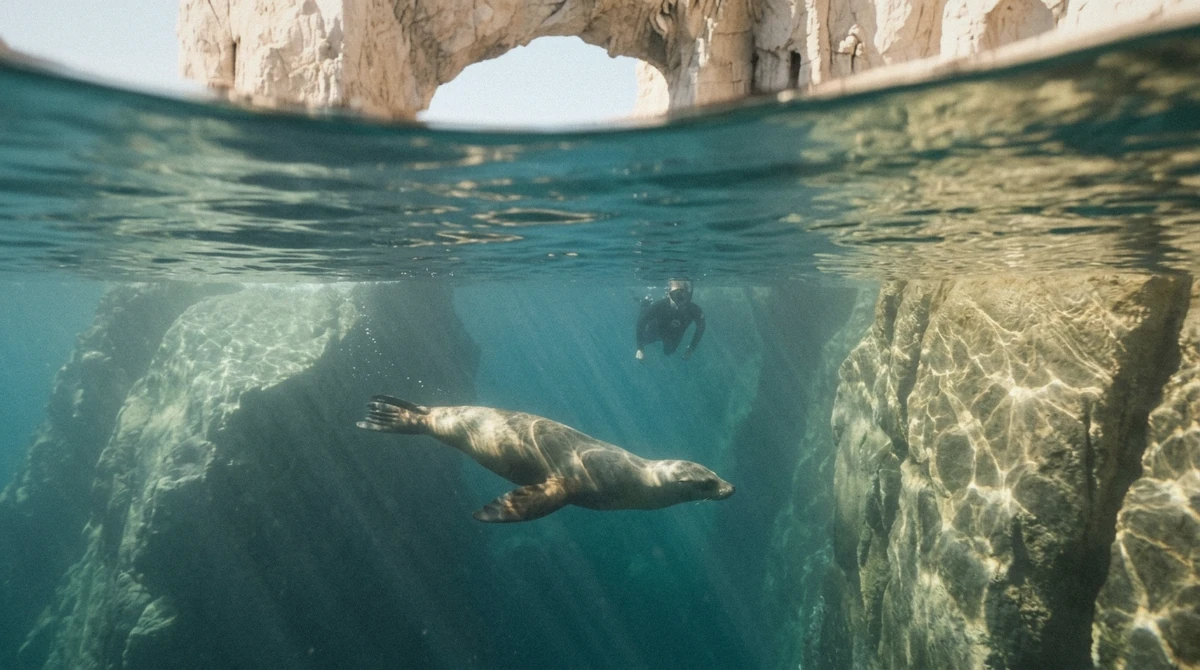
A resident colony of California sea lions lives on the rocks at Land's End year-round, visible from the water on almost every trip that passes that way. There is no walking access, the colony sits on rock reachable only by boat, water taxi or paddle, which is a large part of why it stays as wild and undisturbed as it does.
Sea lions are wild animals protected under Mexican wildlife law, and touching, feeding, chasing or cornering them is illegal, enforced by PROFEPA. Guides in Cabo work to a rule of thumb of about 10 metres, roughly 30 feet, on the rocks and in the water. Whatever the exact figure on paper, the legal line is clear: you do not touch, feed, chase or corner them, no exceptions.
There is no swim-with-sea-lions programme in Cabo San Lucas, and no tour on this site promises one. Curious young animals sometimes come in close on their own to look at a group of snorkelers, and that moment is genuinely one of the best things you can experience in this bay, but it is the animal's choice every time, never a booking you can rely on or a promise a tour is entitled to make.
Where Each One Lives: Spots and Sites
Pelican Rock is where most of the reef fish rows above show up together, king angelfish, sergeant majors, Cortez angelfish, wrasses, moray eels and the occasional pufferfish all sharing the same short stretch of rock and boulder. It is the calmest, most sheltered water in town, which is exactly why it carries the steadiest fish activity on this whole list. The Cabo Arch and Lover's Beach snorkeling tour at $71 is one of the trips built specifically around this stretch.
Land's End and the rocks around El Arco are the sea lion territory, and also where a moray eel is most likely to be found tucked into a deeper crevice. The Land's End Arch sightseeing and Lover's Beach tour passes directly along this stretch.
Chileno Bay carries the biggest reef of the three main spots and the best turtle odds on the list, along with steady parrotfish activity. Santa María adds another reliable stop for the common reef fish in a calmer, horseshoe-shaped bay. Open water between the spots, rather than any single reef, is where a mobula ray sighting is most likely, which is why boats that cover more distance between bays carry slightly better odds for that particular lucky-day encounter.
For confident swimmers chasing the open-water end of this list, the open-ocean snorkel with sharks at $200 covers ground none of the reef-based trips reach, and it is worth reading up on before you book since it is not a beginner outing.
When to Look for Each One
The reef regulars hold station all year, so the calendar below only matters for the animals that come and go. Figures are typical monthly averages, not a forecast for your dates.
| Animal | Season | Where to look | How likely in season |
|---|---|---|---|
| King angelfish and sergeant majors | All year | Pelican Rock, Santa Maria, Chileno | Nearly every trip |
| Cortez rainbow wrasse and parrotfish | All year | Every rocky reef | Most trips |
| California sea lions | All year, most active in the cooler months | The rocks at Land's End | Most trips, from the boat |
| Green and hawksbill turtles | Warm months, roughly May through November | Chileno Bay and the corridor reefs | Regular but not every trip |
| Mobula rays | Spring into early summer | Open water on the crossing | Lucky-day sighting |
| Humpback whales | Roughly mid-December to mid-April | Offshore, from the boat only | Regular but not every trip in season |
| Whale sharks | October to April, in La Paz | Not in Cabo San Lucas at all | Never here |
If your dates are fixed, work the other way round and read the month-by-month guide to snorkeling in Cabo San Lucas first, then set your expectations from the table above.
What You Won't See Here
The one myth worth killing outright: whale sharks are not a Cabo San Lucas snorkel. They are a La Paz attraction, in La Paz Bay, roughly 160 km and about two hours' drive north of Cabo San Lucas, in season roughly October to April. No tour on this site, or any tour departing from the Cabo San Lucas marina, includes a whale shark encounter, because the animals themselves are not in these waters.
The confusion is understandable. La Paz and Cabo San Lucas both sit on the same peninsula, both get lumped together as Los Cabos in a lot of travel writing, and whale shark photos from La Paz circulate constantly online without always naming the actual town. If a whale shark encounter is the whole point of your trip, that is a real, worthwhile experience, it is just a separate destination and a separate booking from anything departing Cabo San Lucas marina, and worth confirming directly with whichever operator you book before you assume it is included.
Rules of the Reef
No touching, chasing or feeding any marine animal here, sea lion, fish, turtle or otherwise. It is illegal under Mexican wildlife law and PROFEPA enforces it, and beyond the law it is simply the difference between wildlife that stays wild and a colony that starts associating boats with food. Swimming ability, currents and the medical restrictions operators actually apply are covered in full on our is snorkeling in Cabo San Lucas safe guide, worth a read alongside these wildlife rules.
Whale watching, when it happens, is governed by NOM-131-SEMARNAT-2010: permitted vessels must stay at least 60 metres back, larger boats 80 metres, unpermitted vessels 240 metres, approach speed capped at 4 km/h, and swimming with whales is not allowed under any circumstance.
Sunscreens containing oxybenzone and octinoxate are restricted inside CONANP-managed marine protected areas, which includes the Cabo San Lucas marine zone, and crews can and do ask guests to rinse off or switch before getting in the water. Mineral sunscreen with zinc oxide, or simply a long-sleeved rash guard, keeps you on the right side of the rule and out of the argument, and honestly protects your back better over a multi-hour trip than sunscreen alone ever does.
How to See More
None of this is luck alone. A few habits genuinely change what you notice on any given trip, the same ones we lean on ourselves after years of doing this every week.
- Book the earliest slot you can, the reef is calmer and fish are less skittish before the day's boat traffic builds
- Swim slowly and let the fish come to you instead of chasing, a fast approach scatters exactly what you are trying to see
- Look into shadowed crevices and under ledges, that is where morays, pufferfish and boxfish actually spend their day
- Ask your guide before the swim what has been showing up that week, they know the reef's current mood better than any list
- Scan open water between reef stops, not just the reef itself, that is where mobula rays and the rare bigger sighting happen
- Stay quiet and keep your fins off the bottom, sediment you kick up ruins visibility for you and everyone near you
- If a sea lion approaches on its own, hold still and let it circle, moving toward it is what sends it back to the rocks
Frequently Asked Questions
What fish will you see snorkeling in Cabo San Lucas?
King angelfish and Panamic sergeant majors on nearly every trip, plus Cortez angelfish, wrasses, parrotfish and moray eels most trips, mainly around Pelican Rock.
Can you swim with sea lions in Cabo San Lucas?
There is no swim-with-sea-lions programme here. A curious animal sometimes approaches on its own near Land's End, but that is always the sea lion's choice, never a tour's promise, and touching or chasing one is illegal.
How close can you get to the sea lions at Land's End?
Guides work to a rule of thumb of about 10 metres, roughly 30 feet. Whatever the exact figure on paper, touching, feeding, chasing or cornering them is illegal under Mexican wildlife law, enforced by PROFEPA.
Are there sea turtles in Cabo San Lucas?
Yes, green and hawksbill turtles, most reliably at Chileno Bay and the corridor reefs with the best odds roughly May through November. It is a regular but not every-trip sighting, never a guarantee.
Can you see whale sharks snorkeling in Cabo San Lucas?
No. Whale sharks are a La Paz attraction, about two hours' drive north, in season roughly October to April. They are not part of any tour departing the Cabo San Lucas marina.
Is it legal to touch marine life in Cabo San Lucas?
No. Touching, feeding, chasing or cornering any wild animal here, sea lions included, is illegal under Mexican wildlife law and enforced by PROFEPA.
Which sunscreen should you wear snorkeling in Cabo San Lucas?
Mineral sunscreen with zinc oxide, since products containing oxybenzone and octinoxate are restricted inside the protected marine zone. A long-sleeved rash guard is the simplest way to avoid the issue and protect your skin over a multi-hour trip.
Last verified: August 2026. None of the sightings above are a promise, the reef changes mood day to day the same way it has for every season we have worked it, but the tiers hold up well enough to plan around. Come with realistic expectations for the lucky-day tier and full confidence in the reef regulars, and snorkel trips to Pelican Rock and Santa María will show you most of this list on an ordinary morning.